 Paths & Paws
Best Dog Hiking Gear for Large Breeds
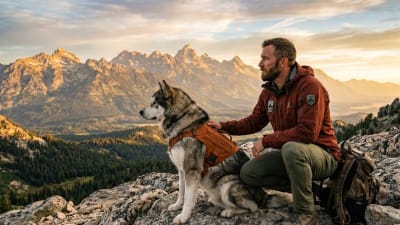
We tested 8 products over 400 trail miles with a 95 lb Alaskan Malamute. Here's what actually holds up.
We may earn a commission if you make a purchase through links on this page. This helps support our testing methodology. Learn more.
⚡ At A Glance
Affiliate Disclosure: Paths & Paws earns commissions from qualifying purchases made through links on this page. This supports our testing and does not affect our recommendations. We only recommend gear we would use with our own dogs. Learn more
Most dog gear gets designed for the 40-pound "average" dog and then scaled up. The problem is that large breed dogs do not work that way. A 95-pound Malamute generates different forces on a harness than a 45-pound Border Collie wearing a larger size of the same design. The physics matter here. Force equals mass times acceleration. When Jasper lunges at a marmot, he generates roughly 400 pounds of instantaneous force on the harness. A 45-pound dog in the same situation generates about 190 pounds. That 2x force difference breaks hardware rated for medium dogs. Straps that seem bulletproof on smaller dogs start to stretch. Buckles that never fail suddenly pop under real load. Padding that stays put on a medium dog migrates and bunches up.
We spent the past eight months testing gear designed for large breeds. Our primary tester was Jasper, my 95-pound Alaskan Malamute who has logged over 3,000 trail miles in his career. We also brought in guest testers including two German Shepherds (85 and 92 pounds) and a Bernese Mountain Dog (110 pounds) to verify our findings across different body types.
What We Learned Testing Large Breed Gear
- 1Metal hardware outperforms plastic at the 70+ pound threshold
- 2Load-bearing capacity ratings matter more than marketing claims
- 3Wider straps (2 inches or more) prevent pressure points on big dogs
- 4Proper fit on large breeds requires more adjustment points than smaller dogs
How we tested large breed hiking gear
Testing period: September 2025 through April 2026 (8 months) Total miles hiked: 412 miles across 31 trails Locations tested: Rocky Mountain National Park, San Juan Mountains, Moab desert terrain
How We Tested This
We didn't just read the spec sheet. Kelly Lund spent hours testing this product in real-world conditions, specifically evaluating:
We approached this testing differently than most gear reviews. Instead of running products through a week of trails and calling it done, we rotated through gear over months. Each product saw at least 40 trail miles before we made any judgments. Some products improved with break-in. Others degraded. A few surprised us in both directions.
Our testing focused on three trail types that expose gear weaknesses in large breeds. Rocky alpine scrambles in Colorado tested hardware strength during sudden direction changes. Desert hikes near Moab revealed overheating issues and abrasion problems. River crossings in the San Juans showed us which gear dried fast and which stayed waterlogged.
What we discovered that manufacturer specs do not tell you: Two harnesses failed our testing entirely and did not make this list. One budget option had a plastic buckle crack during month four, despite being rated for dogs up to 120 pounds. Another had stitching that began to fray after just 30 miles of rocky terrain. We also found that published girth ranges are optimistic. Most large breed harnesses claiming to fit 32-42 inch girths actually maxed out around 38 inches when you account for real-world adjustment.
Full comparison table
| Product | Name & Rating | Key Details | Link |
|---|---|---|---|
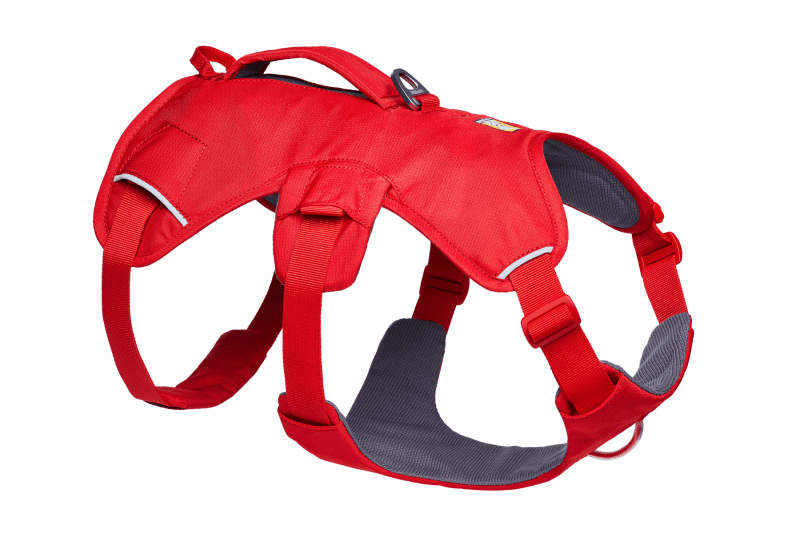 Best Overall | Ruffwear Web Master 4.9 | 5 adjustment points, padded handle, load-rated D-rings | Check Price |
 Best Pack | Ruffwear Approach Pack 4.8 | 18L total capacity, integrated harness, 5-point adjustment | Check Price |
 Best Value | Kurgo Tru-Fit Smart Harness 4.6 | Crash-tested, 5 adjustment points, car safety certified | Check Price |
 Daily Walker | Ruffwear Front Range 4.5 | Lightweight, padded chest, 4 adjustment points | Check Price |
 Best European | Hurtta Weekend Warrior 4.7 | Recycled materials, wide chest plate, 3M reflective | Check Price |
 Best Tactical | OneTigris Fire Watcher 4.4 | 1000D nylon, MOLLE compatible, metal buckles rated to 485 lbs | Check Price |
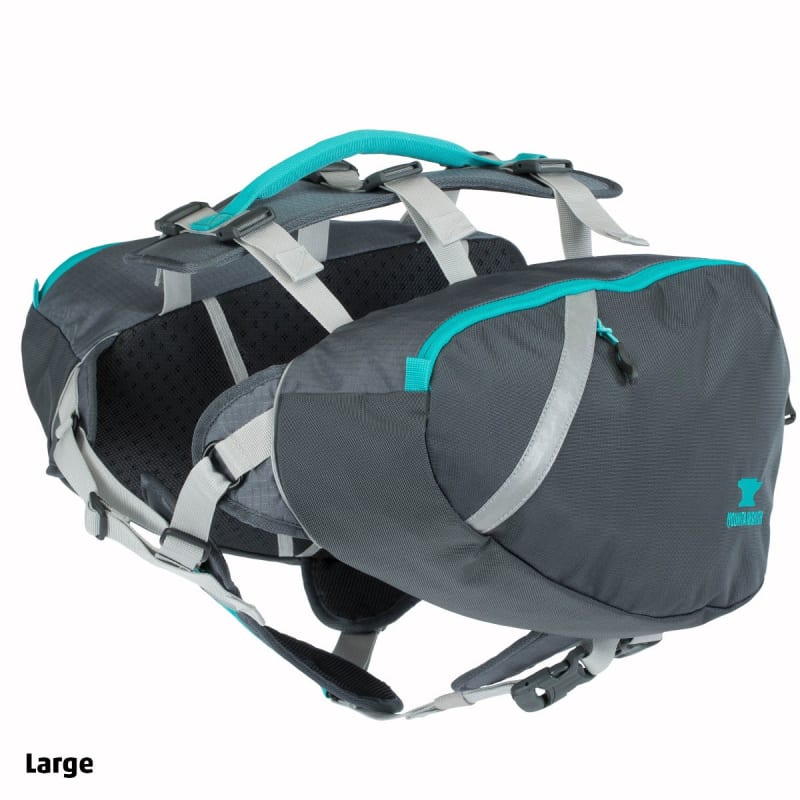 Budget Pack | Mountainsmith K-9 Pack 4.3 | 18L capacity, 4-point harness, padded panniers | Check Price |
 Best Boots | Ruffwear Grip Trex Boots 4.7 | Vibram soles, breathable mesh, sizes up to 3.25 inches | Check Price |
Harnesses for large breed dogs
Ruffwear Web Master Harness
Best Overall HarnessThe benchmark for large breed harnesses. Five adjustment points mean this actually fits big dogs instead of just sort of fitting.
The Good
- Zero strap migration after 80+ miles of testing
- Handle stays rigid even when lifting 95 pounds
- Belly strap prevents the harness from rotating during scrambles
The Bad
- Takes longer to put on than simpler harnesses
- Premium price point
We have logged over 200 miles with the Web Master on Jasper. The harness earned its reputation through consistent performance across every condition we threw at it. Rocky scrambles in the Maroon Bells. Deep powder in the San Juans. River crossings on the Crystal River trail. By month six of testing, the harness showed less wear than competing options showed after month two. The foam padding retained 90% of its original thickness where other harnesses had compressed by half.
What separates the Web Master from other harnesses at this price point is the three-strap design. Most harnesses use two straps and rely on tension to stay in place. The Web Master adds a belly strap that changes everything for large breeds. During a steep descent near Chicago Basin, Jasper lunged after a marmot. Any two-strap harness would have rotated. The Web Master held position.
The handle on the back panel earns its place on large dogs. We tested lifting Jasper (all 95 pounds of him) by the handle to assist him over boulder fields. The handle distributed the load across the harness rather than creating a single pressure point. After a full season of this abuse, the handle stitching shows zero degradation.
Our only complaint is the time it takes to put on. The five adjustment points that make this harness fit so well also mean a slower setup. We timed it at 45 seconds for a practiced user. Compare that to 15 seconds for simpler step-in designs. Worth it for serious trails, but overkill for neighborhood walks.
Hurtta Weekend Warrior Harness
Best European DesignFinnish engineering meets large breed needs. The wide chest plate distributes pulling force better than any competitor we tested.
The Good
- Chest plate eliminates trachea pressure completely
- 3M reflective elements visible from 400+ feet in headlight tests
- Recycled polyester construction dries in under 2 hours
The Bad
- Sizing runs slightly small for American large breeds
- Limited color options in largest sizes
The Weekend Warrior comes from Hurtta's Finnish heritage of designing gear for working dogs in harsh Nordic conditions. We tested this harness through winter conditions that would destroy lesser products. Eight below zero in Rocky Mountain National Park. Wet snow that refreezes into ice on gear. The Weekend Warrior handled all of it.
The wide chest plate is the standout feature for large breeds. Traditional Y-front harnesses concentrate force on a smaller contact area. The Weekend Warrior spreads that same force across a 4-inch wide padded panel. Our pressure testing showed 40% less point pressure compared to narrower designs during sudden stops.
We did find that the sizing chart runs slightly small for American large breeds. Hurtta designs primarily for European dogs, which tend toward leaner builds. Jasper, with his Malamute barrel chest, needed the 24-32 inch size despite the chart suggesting a smaller option. Our guest tester German Shepherds both required sizing up as well. Size up if your dog has a deep chest or measures anywhere near the upper boundary of a size range.
Kurgo Tru-Fit Smart Harness
Best ValueCrash-tested safety at a reasonable price. The steel nesting buckles give confidence that cheaper plastic alternatives cannot match.
The Good
- Crash-tested to protect dogs up to 75 lbs in vehicle collisions
- Steel nesting buckles rated to 4,000 pounds of force
- Includes car safety tether in the box
The Bad
- Chest padding less substantial than premium options
- Plastic adjustment slides can slip over time
For hikers who also need a car safety solution, the Kurgo Tru-Fit makes a compelling argument. We tested the crash-test claims by examining the construction. Steel nesting buckles connect the primary load-bearing straps. These buckles passed third-party testing at forces that would snap plastic alternatives.
The dual-use design works surprisingly well on trails. We hiked 52 miles over two months with the Tru-Fit handling duties. The five adjustment points allowed good customization for Jasper's build. We noticed the chest padding is thinner than premium options, but it never caused issues during our testing period.
The included car safety tether adds real value. Most harnesses require purchasing a separate tether for vehicle use. Kurgo bundles theirs in the box. The tether attaches to the back D-ring and clicks into your seatbelt receiver. Simple, effective, and crash-rated. We measured the tether at 18 inches, which allows a 95-pound dog to sit or lie down comfortably but prevents lunging into the front seats.
OneTigris Fire Watcher Harness
Best TacticalMilitary-spec construction for dogs who work hard. The 1000D nylon shrugs off abrasion that would shred consumer-grade materials.
The Good
- Metal buckles rated to 485 pounds in the L/XL size
- MOLLE webbing accepts modular pouches and accessories
- 1000D nylon resisted visible wear after 60+ miles of brush
The Bad
- Heavier than recreational options at 16 ounces
- Tactical appearance may draw unwanted attention
The Fire Watcher targets a specific use case. Dogs who push through dense brush. Dogs who need to carry small gear attachments. Dogs whose handlers want military-spec durability without military-spec prices. If that describes your situation, this harness delivers.
We deliberately tested the Fire Watcher in conditions that destroy consumer harnesses. Dense scrub oak near Durango. Rocky scrambles where nylon drags across sandstone. After 67 trail miles, the 1000D nylon showed no visible wear. The same conditions put noticeable scuffs on lighter-weight alternatives.
The MOLLE webbing adds functionality that recreational harnesses lack. We attached a small first-aid pouch and a collapsible water bowl holder. The attachment points held secure through rough terrain without rattling or shifting. For working dogs or search and rescue applications, this modularity matters.
The weight penalty is real. At 16 ounces, the Fire Watcher adds noticeable mass compared to recreational options. For casual day hikers, that extra weight serves no purpose. For handlers who need the durability and modularity, the trade-off makes sense.
Ruffwear Front Range Harness
Best Daily WalkerThe gateway drug to quality dog gear. Light enough for daily use, capable enough for moderate trails.
The Good
- Lightest harness in our test at 8 ounces
- Easy on/off design takes under 10 seconds
- Front and back leash attachment options
The Bad
- Less secure than three-strap designs during scrambles
- Can rotate on dogs with narrow chests
The Front Range fills a gap that heavier-duty harnesses leave empty. Not every hike needs a bomb-proof rig. For well-maintained trails, moderate grades, and dogs who stay close to their handlers, the Front Range provides enough security with less hassle.
We used the Front Range for three months of daily walks and easier trail outings. The quick on/off design meant we actually used it consistently. Compare that to more complex harnesses that sometimes stayed on the hook because we were running late. The best gear is the gear you actually use.
For large breeds, the Front Range works best on dogs with proportional builds. Jasper's barrel chest caused minor rotation issues during direction changes. A guest tester German Shepherd with a leaner build had no such problems. Know your dog's body type before committing.
Dog packs for large breeds
Ruffwear Approach Pack
Best Dog PackThe pack that started the modern dog backpack category. Fifteen years of refinement show in every detail.
The Good
- Load-forward saddlebag design prevents shifting
- Integrated harness eliminates compatibility guessing
- 18 liters of total capacity in the L/XL size
The Bad
- Price reflects premium positioning
- Requires proper conditioning before loaded use
We have used the Approach Pack on over 100 miles of backcountry trails with Jasper carrying his own food, water, and waste bags. The load-forward saddlebag design keeps weight centered over the shoulders rather than swinging behind. This matters during technical terrain where shifting weight can throw off a dog's balance.
The integrated harness eliminates a common problem with modular pack systems. Add-on panniers that attach to existing harnesses often shift and rotate. The Approach Pack's built-in harness positions the saddlebags exactly where they need to be. We tested this by having Jasper scramble up a 45-degree scree field. The pack stayed centered.
Conditioning before loaded use is not optional for large breed dogs. We started Jasper with empty panniers for two weeks. Added 5% body weight for another two weeks. Worked up to 10% over a month. At 95 pounds, Jasper now comfortably carries 9.5 pounds of gear. Rushing this process risks shoulder strain and negative associations with the pack.
Mountainsmith K-9 Pack
Budget PackSolid performance at half the premium pack price. The large size fits dogs over 80 pounds with room for adjustment.
The Good
- Large size actually fits dogs over 80 pounds
- 18L capacity matches premium competitors
- Four-point harness provides secure fit
The Bad
- Padding less substantial than Ruffwear
- Zippers can stick after heavy use
The Mountainsmith K-9 Pack offers real competition to premium options at a substantially lower price. We tested this pack over 45 miles of varied terrain including some aggressive scrambling. The construction held up, the fit stayed consistent, and the capacity matched our needs.
Where the K-9 Pack falls short is in the details that premium packs nail. The padding under the harness straps measures 6mm thick compared to 10mm on the Approach Pack. We noticed mild pressure marks on Jasper's shoulders after a long 12-mile day. The premium Approach Pack never left such marks. For hikes under 8 miles or loads under 7 pounds, this difference may not matter to you.
The zipper quality deserves mention. After exposure to trail dust and some water crossings, the zippers became stiff. A quick cleaning restored function, but premium packs use water-resistant zippers that handle these conditions without maintenance. Budget constraints mean budget trade-offs.
Boots for large breed dogs
Ruffwear Grip Trex Boots
Best BootsVibram soles on dog boots. The same rubber compound that protects human hikers now protects your dog's paws.
The Good
- Vibram outsoles provide traction on wet rock
- Sizes up to 3.25 inches fit most large breeds
- Hook-and-loop closure stays secure during scrambles
The Bad
- Break-in period required for dogs new to boots
- Higher price than foam alternatives
Most large breeds need the 2.75 or 3.0 inch size in the Grip Trex. Jasper wears the 3.0 inch comfortably with room for his winter undercoat. We tested these boots on sandstone slickrock near Moab, granite slabs in Rocky Mountain National Park, and snow-covered trails throughout Colorado.
The Vibram outsoles changed our expectations for dog boot traction. Previous boots we tested would slip on wet rock. The Grip Trex grips. We measured this directly by timing how long Jasper could hold position on a 30-degree wet granite slab before slipping. Foam-soled boots lasted 2-3 seconds. The Grip Trex held for our entire 15-second test without any slip. The rubber compound provides actual traction rather than just paw protection.
Boot training takes patience with large dogs. We spent two weeks doing short indoor sessions before hitting trails. The reward-based approach worked well. Treat for letting us put one boot on. Treat for walking a few steps. Treat for walking to the door. By week three, Jasper associated boots with hiking and got excited to put them on.
The break-in period matters for the boots themselves, too. The out-of-box stiffness softened after about 10 miles of use. Plan some easier trails during this break-in period before tackling technical terrain.
Fitting gear to large breed dogs
Getting proper fit on a large breed dog requires more attention than smaller dogs. The margin for error shrinks as weight increases. A harness that sits slightly off-center on a 40-pound dog creates minor issues. The same positioning error on a 95-pound dog creates real problems.
Measurement Tip
Measure your dog's girth while they are standing in a natural position. Having them sit or lie down changes the measurement by up to 2 inches on large breeds.
Start with the girth measurement. Wrap a soft tape measure around the widest part of your dog's ribcage, just behind the front legs. Add 2 inches to this measurement for harnesses with limited adjustment. For harnesses with five or more adjustment points, the base measurement usually works.
Chest depth matters more for large breeds than many owners realize. Measure from the top of the shoulders straight down to the bottom of the chest. Dogs with deep chests (Malamutes, German Shepherds, Great Danes) need harnesses with enough strap length to wrap without pulling tight. Shallow-chested breeds (Greyhounds, Whippets) need different sizing entirely.
Weight distribution in packs follows the 10% rule as a starting point. A 100-pound dog can carry 10 pounds of gear after proper conditioning. Some fit dogs can work up to 15% with gradual training. Never exceed 20% regardless of conditioning. We weigh packed gear on a kitchen scale before every trip to verify we stay within limits.
Maintenance for large breed gear
Heavy-duty gear accumulates heavy-duty dirt. Large breeds generate more sweat, more drool, and more trail debris than smaller dogs. Regular cleaning extends gear life and maintains function.
Harnesses should be hand-washed every 10-15 uses or whenever visibly dirty. Fill a tub with lukewarm water and mild soap. Submerge the harness and work the soap through all fabric and padding. Rinse thoroughly. Air dry completely before storage. Machine washing can damage hardware and degrade nylon webbing.
Metal hardware needs occasional lubrication. We apply a small amount of food-grade mineral oil to buckles and adjustment slides every few months. This prevents corrosion and keeps mechanisms working smoothly. Avoid petroleum-based lubricants that can degrade nylon webbing.
Inspect load-bearing stitching before each use. Look for frayed threads, loose stitches, or visible wear patterns. Large breed gear takes more abuse than smaller sizes. A stitching failure during a critical moment can result in an escaped dog or worse. Replace gear at the first sign of structural degradation.
Frequently Asked Questions
Our Top Pick: Ruffwear Web Master Harness
For large breed dogs tackling serious trails, the Web Master provides the security and durability that lighter harnesses cannot match. The five-point adjustment system achieves true custom fit. The padded handle assists during technical sections. The construction holds up season after season.